Ever wondered how short a yoctosecond is?
Measuring the timing jitter between optical pulse trains with yoctosecond-per-root-Hertz resolution.
Over the past decade, our group has made great strides in terms of oscillator performance (see our other research projects). While that was all exciting, it has also created a new issue, as it meant that we would need to find new ways of measuring such low levels of noise. Out of this necessity, we created a measurement setup, which enables us now to measure the jitter between two optical pulse trains with a resolution of the order of yoctoseconds per root Hertz (ys/√Hz).
So how small is a yoctosecond? Pretty small! In fact it is currently the smallest SI unit of time that has a name (after zepto, atto, femto, pico, nano, micro, milli seconds; each of which is a thousand times smaller than the previous unit). In numbers, if you have to know, 1 ys is s or: 0.000000000000000000000001 s.
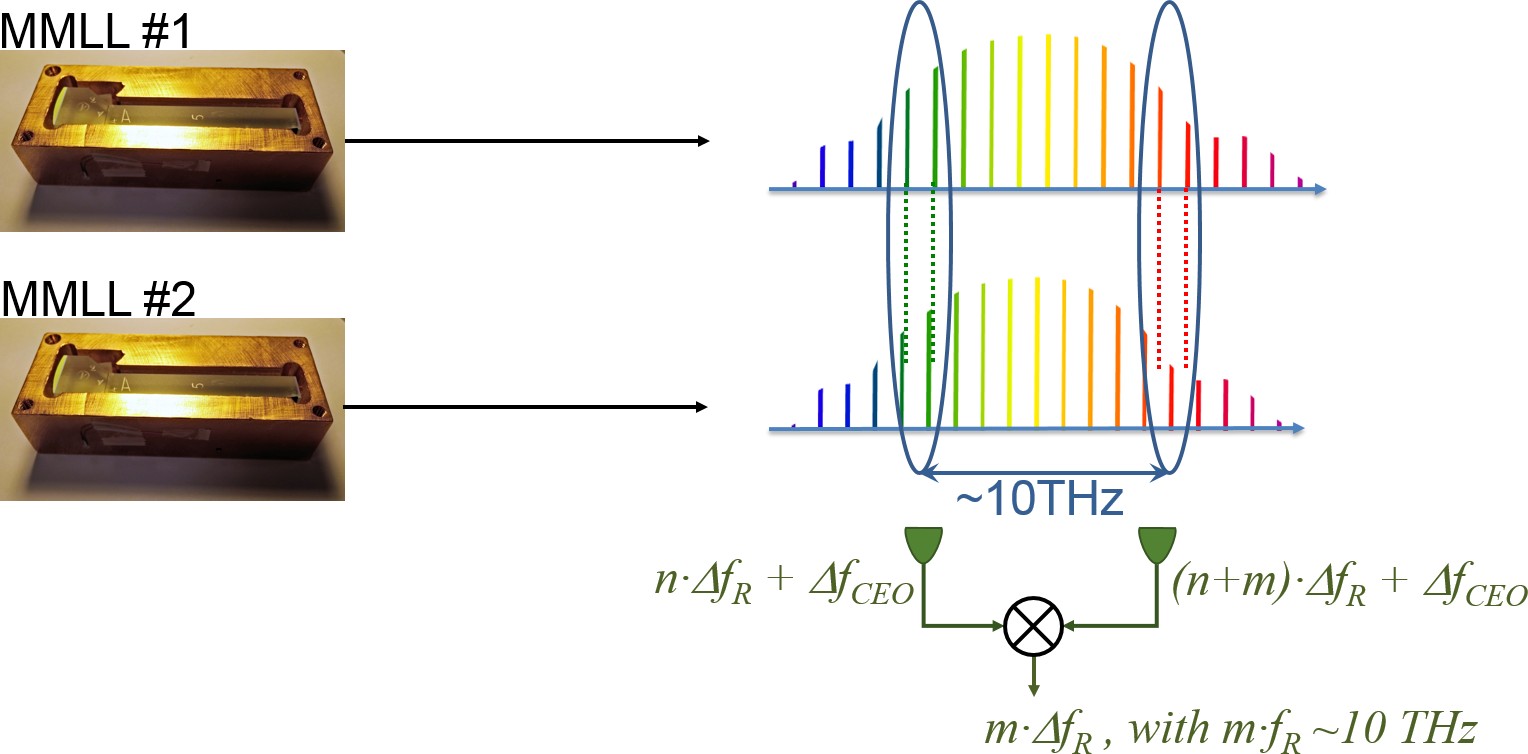
The basic idea behind this method is that the relative jitter in the pulse train is encoded in the optical phase between the optical spectra (i.e. frequency combs). This phase can be measured relatively simply by generating heterodyne beat notes between the two combs at different locations in the optical spectrum. The benefit is that a timing shift of a few femtoseconds will lead to a full 360 degrees of phase in the beat notes. With sufficient signal to noise (limited by shot noise, which is basically the quantum noise floor of the measurement), this few-femtosecond shift can be resolved to a few millionths of a degree, leading to sub-zeptosecond resolution. For this to work the pulses need to be overlapped in time, but that’s a relatively simple requirement, considering that the pulses are typically ~100 fs long, and we want to measure jitter in the attosecond range and below.
More details about this approach can be found in Optics Letters 40, 2985 (2015).