Ultra high-Q optical microresonators
Whispering-gallery-mode glass resonators with Q-factors beyond ten billion – thousands of times better than the best quartz crystals.
An optical cavity or optical resonator is a device that forms a standing wave (in case of a linear arrangement) or a traveling wave (in case of ring-like arrangement) for light waves. Optical cavities are a major component of lasers, surrounding the gain medium and thus providing feedback of the laser light. They are also used in optical parametric oscillators, in some interferometers or in ultra-sensitive detection systems. Optical resonators are typically formed by a set of mirrors arranged in a way to reflect light onto itself, i.e. light of a specific frequency will be trapped inside the resonator. Depending on the reflectivity of the mirrors, Q-factors of the order of ten to one hundred billions can be achieved.
A major drawback of optical resonators formed by mirrors is their bulkiness and sensitivity to environmental influences. One has to go to great lengths to sufficiently isolate an optical resonator from environmental influences to be able to reach either the quantum or the thermal noise limit.
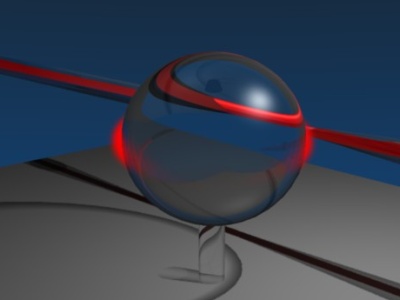
Entirely without mirrors, optical cavities can also be formed by what is known as total internal reflection. In this case, light is trapped inside a transparent medium with a refractive index that is higher than the refractive index of the environment. In the simplest case, such resonators can be produced by melting the tip of an optical fiber, which results in a tiny glass sphere measuring only a few 100 microns in diameter. The high purity of the fiber material allows optical Q-factors in excess of a billion. A more elaborate way of producing toroidal structures and many interesting applications can be found here.
… practically by melting a piece of glass, optical resonators with Q-factors in excess of ten billions can be obtained. This is thousands of times better than the world’s best quartz crystals.
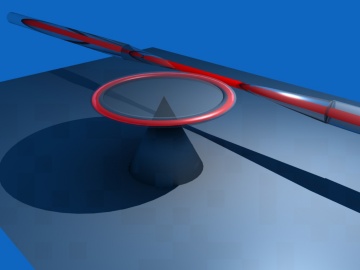
Such cavities are interesting candidates for a large variety of applications, such as cavity quantum electrodynamics, sensing of single atoms or molecules, or for a variety of cavity optomechanics experiments. If one could fully exploit the high Q-factors of such structures, tiny ultrastable optical oscillators might become feasible.
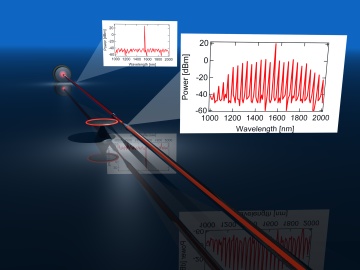
Early optical frequency combs were based on intracavity phase modulation and more recently on phase-stabilized mode-locked lasers. A new approach promises to shrink the size and complexity of optical frequency comb generators by many orders of magnitude. The approach is based on cascaded four-wave mixing (FWM) inside ultrahigh-Q optical whispering gallery mode (WGM) resonators. The high Q-factors and small mode volumes lead to large intracavity intensities at low input powers. Del’Haye et al. have shown that with as little as 200 mW octave-spanning combs can be realized.