Chip-scale mode-locked lasers
Monolithic femtosecond sources based on integrated optics – towards fs-lasers on a chip.
Lasers that produce pulses with femtosecond durations (1 fs = 10⁻¹⁵ s) have found a large variety of scientific and commercial applications. Length, distance and optical frequencies are now routinely measured with fs-lasers. Optical frequency combs produced by fs lasers are key technology to probe and manipulate the quantum state of atoms or molecules, and in vivo 3D imaging with micrometer resolution is achieved by optical coherence tomography using fs-lasers as light sources. Fs pulses are also indispensable for the investigation of electron dynamics in solid-state materials, such as in novel nano-structured metamaterials.
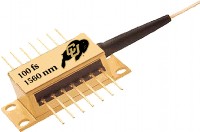
An increasing number of applications require local oscillators with ultra-low timing jitter. An example of these applications is ultra-high-speed analog-to-digital conversion (ADC), which is extensively used in software-defined RADAR and radios. The performance of such high-speed ADCs is ultimately limited by the timing jitter and power of their local oscillators. For example, a 12 bit ADC at a 10 GHz input frequency requires a timing jitter of less than 4 fs. This low jitter cannot be obtained by state-of-the-art room-temperature microwave oscillators, but it is possible to achieve sub-fs jitter with actively stabilized optical frequency combs.
Our chip-scale mode-locked lasers project targets the development of monolithic femtosecond sources based on integrated optics, ultimately leading to fs-lasers on a chip. Such sources enable not only a dramatic reduction in size but also a vastly improved immunity against environmental influences. This leads to mode-locked lasers that operate close to the quantum limit.
Chip-scale mode-locked lasers […] could find their way into our households similar to the cw laser diodes some thirty years ago.
Mode-locked semiconductor lasers certainly would qualify for applications outside the protected environment of the optics laboratory. However, their performance is severely restricted by the short lifetime of the gain inversion (typically 10 ns or less). Compact and rugged fiber lasers on the other hand have recently proven suitable for precision optical measurements and for generating fs-combs at the highest level of precision, but none of these systems qualify for integration in an instrument nor could they be operated by laypersons. A variety of applications we are foreseeing for these sources are:
- Optical telecommunication, possibly employing DWDM, optical-phase-shift keying.
- Optical A/D conversion on a chip at hundreds of GHz; optical signal processing.
- Remote sensing and portable distance measurements with ultrahigh resolution.
- Portable gas analyzers based on optical frequency combs.
- THz generation, THz imaging and tomography with built-in chemical analysis.
- Pump-probe systems with no moving parts using two synchronized chip-scale lasers.
- Optical arbitrary waveform generation.
- Turn-key optical frequency combs.
Challenges
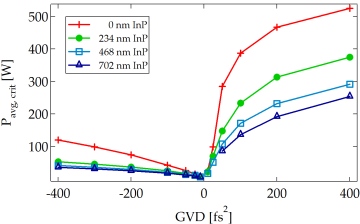
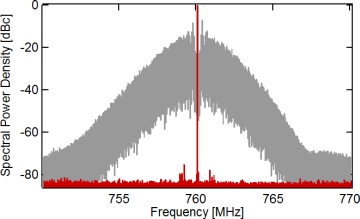
Making state-of-the-art solid-state lasers smaller brings a variety of challenges. Two of the most severe challenges are material damage (especially if III-V semiconductor absorbers are used), and dynamic instabilities, such as Q-switching instabilities. Both of these issues are related to the high repetition rate and the limited intracavity pulse energy in compact lasers. The latter can be overcome by passive means (namely intracavity dispersion management, and inverse saturable absorption; see Fig. 3), or by active feedback methods (see Fig. 4).
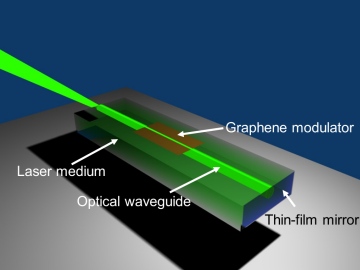
To overcome both the material damage and Q-switching issues, we have developed graphene-based saturable absorbers that enable active modulation of the intracavity loss, as well as passive mode-locking owing to the intrinsic saturable loss of graphene (see graphene-based devices).